
Goa
Saturday, February 17, 2018
About Goa: Goa is a state in India within the coastal region known as the Konkan in Western India. It is bounded by Maharashtra to the north and Karnataka to the east and south, with the Arabian Sea forming its western coast. It is India's smallest state by area and the fourth smallest by population. Goa is India's richest state, with a GDP per capita two and a half times that of the country. It was ranked the best-placed state by the "Eleventh Finance Commission" for its infrastructure and ranked on top for the best quality of life in India by the National Commission on Population based on the 12 Indicators.
Duration of the Trip: This was 5 days and 6 night’s trip from Bangalore. We started on Tuesday night and return back to Monday morning.
Transportation: There are multiple modes of transportation available from Bangalore to Goa, including bus, train, and flight. The best mode of traveling to Goa is a long drive from Bangalore.
However, the mode we choose was a flight from Bangalore to Goa and for returning back we opted for a bus from Goa to Bangalore. This is considering the budget and available leaves we had.
Details of the Trip:
Night 1: We boarded the flight from Bangalore at 11:00 pm which was due at Goa around 12:00 am. But due to some technical issues, we finally landed at Goa around 12:30 am.
So after making and canceling and remaking plans for last 6 years, here we are in Goa!! Finally!! But then, which Indian has reached Goa in their very first plan? :P :P
We came outside of the airport after collecting our luggage and hired a cab from the prepaid taxi stand at a cost of Rs 250/-. Though the distance was not of Rs 250/-, due to late night, the charges were high.
We checked in at Vasco Residency (a Government of Goa undertaking) near Vasco Da Gama railway station. We booked the hotel online beforehand. So they allowed us to check-in at the wee hours of the night. Tariff for a night was Rs 1400/- per night. Though the hotel is in the city, as it was not near to any beach, we had booked the hotel only for the night with plans of moving to beach front next day morning. The hotel was very under maintained and not for staying a long time.
Day 1: After waking up, we ordered breakfast in the room service. They had very limited options and quite high priced. As I already mentioned, we booked Vasco Residency just for one night, we checked out from there by 11 am. We called the same driver who dropped us previous night (Bitti: +919049158267) for dropping us at Om Sai Beach Hut at Agonda Beach. Bitti charged us Rs 1900/- for dropping.
The Agonda beach was very clean and with very less crowd, a perfect place to spend leisure time in Goa. We had booked a hut for 4 nights at it cost used Rs 10,476.00/- inclusive all the taxes. Agonda beach is one of the south sides beaches and really far from the famous tourist spots and beaches of Goa. So, this place is not for the people who are in Goa for the beach parties but definitely a heaven for the peace lovers.
Once we settled down in the room, we went to the seaside restaurant of Om Sai Hut and had our lunch with famous kingfish and fenny ( a definitely not be missed when in Goa). Food was delicious and not really expensive.
We spent the evening by sea bathing, thrift shopping and chilling out on the beach in front of our hut.
Oh yes, we also booked a cab for sightseeing for next 3 days from the travel agent Vilas ( contact numbers: +91-9421246036, + 91-9921245389) at a cost of Rs 6000/-. Sounds expensive? But once u read the entire post, you would definitely feel it was the cheapest deal possible in Goa.
We had our dinner in the restaurant of another beach hut called White Sand.
Day 2: After getting up, we went for a walk on the beach. Nothing can be more relaxing and refreshing than early morning beach. It just washes out all the negative things from the mind. This is the most divine feeling to be wherever I am in any of beach places.
We had our breakfast in the restaurant of Om Sai beach hut and started for the sightseeing by 9:30 am with Vilas. The places we visited are
Fort Aguada and its lighthouse is Portuguese fort which was constructed in 1612. This was the most prized and crucial fort for Portuguese. Built on the mouth of river Mandovi, it was strategically located and was the chief defense of Portuguese against the Dutch and Marathas. A freshwater spring within the fort provided water supply to the ships that used to stop by. This is how the fort got its name: Aguada, meaning Water.
Later during the Salazar Administration, Fort Aguada was repurposed for use as a prison primarily.
There is no entry fee for this place.
Calangute Beach is the largest beach in North Goa and visited by thousands of people every day. During the peak season, this beach gets really crowded. This beach offers different kind of water sports like parasailing, banana boat, water skiing and many more.
Also, outside the beach, there are lots of stores for buying local Goa t-shirts, junk jewelry, and other stuff.
After spending a day in the serene environment of Agunda beach, this place was a real disaster for me. Crowded and dirty beach, people with inappropriate attitude was a big turn down and we spent a very less time and left the place.
Baga Beach is the most famous beach in North Goa. This beach is named after the Baga Creek which is located at the end of the beach. Like Calangute beach, this place is also famous for different water sports, local stuff. This place also had a variety of restaurant serving awesome seafood.
This beach was also very very crowded but either it was better than Calangute or we had got used to by the crowded beach and stopped comparing them with south Goa beach, we choose to go for parasailing.
The charge for parasailing while booked in Rs 800/- while booked from the beach. This includes the boat charges for going till the point of parasailing and going up till 30ft height. There are multiple top-ups which can be added in this. Rs 500/- for going to the full height which is approximately 50ft and staying there for 2-3 minutes; Rs 600/- for going up to full height and coming down and taking dip till waist; Rs 800/- for going up to full height and coming down and taking full body dip. I opt for the package of Rs 500/- as I was not carrying any extra set of dress.
We made a mistake of not caring our extra dress but the bigger mistake was not carrying the camera to the boat. One can carry all their stuff and it's completely safe.
Baga beach is also famous for the Goa nightlife.
Anjuna Beach is another famous beach in Goa. Unlike, other beaches this beach is more of rocky than sandy. Anjuna beach is also famous for its trance parties held during the peak tourist seasons.

Every Wednesday the famous flea market is held in Anjuna where you can purchase products from all over India, as well as from foreigners, ranging from fruits to jewelry, clothes, hashish and electronic devices.
From the boat riders of our parasailing, we heard there are places for paragliding in Anjuna beach however we couldn't find any, but then didn’t search much as well.
We had our lunch in one of the restaurants of Anjuna beach. By the time we finished our lunch and started for the destination, it was around 4:30 pm and we headed for Dona Paula.
Dona Paula beach is situated at the Sangam of the Arabian Sea and Goan rivers Mandovi and Zuari. There are lots of local legends about the place Dona Paula beach. One of the most famous is, Dona was married to Paulo, a lowly fisherman. He ventured into deep seas for fishing and is said to have never returned. His dutiful wife Dona supposedly waited for him at the jetty, for so many years that she finally turned into stone, which is the famous statue we can see at the jetty.
However, the truth is, Paula Amaral Antonio de Souto Maior. She was married to a Fidalgo from Spain, Dom Antonio Souto Maior. South Maiors was an extremely affluent family, and the entire property from the present day Cabo Raj Nivas all the way to Caranzalem belonged to the Souto Maior’s. Dona Paula was a woman of charity and is known to have helped the villagers and worked a lot for their betterment, so after her death, the villagers decided to rename the village as Dona Paula.
Another famous local legend goes that Dona Paula is supposed to be seen emerging from the moonlit waves wearing only a pearl necklace. Several tourists, as well as locals guided by this myth, visit the beach for a glimpse of Dona Paula.
While listening all the legends and stories about Dona Paula from our driver Vilas, we enjoyed the enriching sunset.
Oh yes, how can I miss the Bollywood value of this place! This is the place where famous scenes of the movie Singham was shot. One can witness lots of nimbupani, tea stalls are named as Singham ;)
The next place was Miramar Beach. But we had had enough of our beach darshan and were extremely tired and post-sunset it became dark also. So, we decided to skip Miramar beach and headed for our hut.
We reached back Om Sai Hut by 9:00 pm. After enjoying a delicious candlelight dinner at the sea beach, we called it a day.
Day 3: This was the busiest day for us in Goa. The previous day we covered the north Goa beaches, so how can we miss the south Goa beaches. Also, we covered the famous old Goa churches and the not to miss in Goa, Cassino. Here is how the day went for us, After finishing the breakfast we went to the south Goa beaches and the first place on our list was
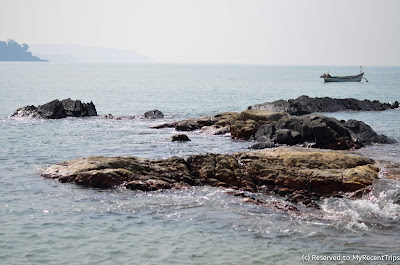
Patnem Beach is much smaller and less crowded beach than the north Goa beaches. But the roads are very narrow which causes a traffic blockage. On top of that the day we visited, there were quite a number of cars and the entrance was completely blocked. Because of the same, our driver took us to another side beach which was completely empty and Patnem beach was within walking distance from this place. But we decided to spend some time there and leave the actual Patnem beach. The place was rocky, calm and serene and quite a photogenic place.
Next, we visited Palolem Beach, another beautiful and cozy south Goa beach. This beach also has quite a number of beach huts and it must be a superb experience to stay there.
Apart from the beautiful, silent beach, another special attraction of Palolem beach is thrift shops alongside the road. It has a long spread of thrift shops with an awesome collection and much cheaper than the shops of North Goa. We did some shopping there before heading back to our hotel.
Part two of the day started shortly after having lunch and getting a bit freshened up. The places we visited are
Cabo-De-Rama fort is named in the honor of Lord Rama. It is said that the fort was home to Lord Rama and Sita during their exile.
The Cape is crowned with the Fort since ancient times. The fortress was built by Hindu rulers, but during its dramatic history it passed from hands to hands – Muslims, Portuguese, English succeeded one another in the possession of this amazing architecture masterpiece. Some of the most important battles in Indian history took place here.
Restored by the Portuguese in 1763 the Fort had 21 cannons, a chapel, military barracks and commandant's room. From 1935 till 1955 the Fort was used as a prison but then was abandoned. Now the main entrance into the fortress is reconstructed, but the rest of the citadel still lies in ruins, and only one of the walls is completely preserved. Nevertheless, Cabo de Rama Fort is a very attractive touristic attraction.
From the top of the fortress really magnificent view onto the Arabian Sea and the Goan coastline appears to the eye.
Rajbag Beach is another beautiful beach. If one wants to stay amidst nature, then Rajbag beach is definitely the place to consider.
Basilica of Bom Jesus is located in Old Goa, the capital of Goa during Portuguese days. Construction of this basilica started during 1594 and the church was consecrated in May 1605. In current days this places is can be considered as one of one of the most famous churches in Goa or perhaps in India.
We couldn’t go inside the main altar of the church as it was booked for a private marriage. However, we could visit the courtyard and the display hall.


One more interesting fact about this church is, the body of St. Francis Xavier is kept inside the basilica. After death, the body of Francis Xavier was first taken to Portuguese Malacca and two years later shipped back to Goa. It is said that the saint's body was as fresh as the day it was buried. Every ten years, the remains of the saint are kept for public viewing during his death anniversary and still attract a huge number of tourists from all over the world. The saint is said to have miraculous powers of healing and many believe that his nails grow till now.
Apart from the exhibition days of saint’s body, it is kept in a silver casket on top of a mausoleum.
The basilica in houses the Bom Jesus Basilica Art Gallery, containing the works of the Goan surrealist painter, Dom Martin.The basilica closes at 6:00 PM.
The Sé Catedral de Santa Catarina, known as Se Cathedral, is the cathedral of the Latin Rite Roman Catholic Archdiocese of Goa and Daman and the seat of the Patriarch of the East Indies. It is located in Old Goa, India.
The Se Cathedral's tower houses a large bell known as the "Golden Bell" on account of its rich tone. It is said to be the largest in Goa, and one of the best in the world. The main altar is dedicated to Catherine of Alexandria, and there are several old paintings on either side of it. On the right, there is a Chapel of the Cross of Miracles, where a vision of Christ is said to have appeared in 1619. There are six main panels, on which scenes from the life of Saint Catherine are carved. There is a huge gilded reredos above the main altar.
The Se Cathedral also houses a baptismal font made in 1532 which was used by Saint Francis Xavier in order to baptize several Goan converts.

This church also closes at 6 PM.
The Our Lady of the Immaculate Conception Church is located in Panjim, Goa. This church was first built during 1541 as a chapel however during the 1600s it was replaced by a larger church. n the 18th century the stairways, in a symmetrical zigzag form, were added to the church. The second largest church bell in Goa was installed in a bell tower in 1871.

By the time we reached Panjim, the church was closed so we couldn’t visit the church. However, from the external view, this was the church I liked most.
After a lot of church visiting, it was time for some making some sin :P.
We headed to Casino Pride, one of the premium casinos in Goa. We parked our car opposite to the church at Panjim and walked up to the casino. One needs to keep in mind that all the casinos have a dress code like formals and no shorts and no flip-flops. Entry is strictly prohibited without a proper dress code. Camera, laptop etc are strictly not allowed inside the casino. However, they also have locker facility to keep your belongings.
Entry fees for the casino are Rs 2000/ per head. After buying tickets from the office, we had to board the boat of Casino Pride to reach actual Casino which is situated on a ship in River Mandovi. While buying tickets they give Rs1000/- worth of coupon which can only be used in roulette table and has to be used in multiple of 500/- and also only for limited kind bets. So basically the coupon can be considered as waste.
Also, they have unlimited food and drinks at the table. But the kind of time they take between taking an order and delivering the food, no one will be in the single table. So, that also can be considered as waste.
But if we ignore the freebies at Casino Pride, it is a really good casino with a number of roulette tables and other games. On one of the upper floors, they have a good restaurant and bar as well.
Taking pictures is strictly prohibited inside the casino.
After we were done at the casino, we had dinner at a really nice restaurant called Sher-e-Punjab near to Panjim church and headed for agenda beach. We reached our hotel by 12:30 am.
Day 4: This was a day of complete leisure. We spent entire day sea-bathing, resting. We took our lunch at H2O Agonda, a place with great food and ambiance. We had our dinner at Dunhill, Agonda, another great place.

Day 5: This was the most happening day for me on this trip. We booked a Scuba Diving from Dive Goa, SinQ Beach Club. We booked the tickets from Atlantis Water Sports at Rs 3999/- per head. But there was a discount of Rs 499/- for sharing their link on Facebook. So, we had to pay Rs 7000/- for two.
We started our day really early at around 4:30 am and checked out from the hotel at Agonda and headed to Dive Goa which is near to Taj Holiday Village. Reporting time at the divining center was 7:00 am. After filling the declaration form, we had a small session on using breathing using oxygen cylinder, do’s and don’ts during diving and sign languages to be used inside water.
We had our breakfast at diving center and headed for SinQ beach. In case one doesn’t have any personal vehicle, the diving center arranges a vehicle for pick up and drops to the SinQ beach from the diving center. After loading all the equipment, oxygen cylinders and some snacks in a boat, we started for Grand Island, the actual diving point at around 9:30 am. After an hour of a scenic boat ride, we finally reached the destination.

There were 5 instructors with us and we were approximately 20 people on board. They got us ready by putting fins, oxygen masks, and oxygen cylinder and one instructor took one person at a time. Finally when my turn came and I was just not able to move due to excitement, tension and a heavy oxygen cylinder being tied to me. But somehow, they managed to get me jumped and it felt like I am drowning inside and water for good and will never be able to come back. But that was just a matter of few seconds and I came out of water floating.
My instructor Kishor was awesome. Before taking me back into the deep water, he made me rehearse all the instruction once again so that I don’t miss breathing or get pain or hurt. Then the moment came when we started going down. With every foot we went inside, the beauty of underwater life came exposing itself.
It was around 20 minutes of dive. We visited a sunken ship and with lots of underwater flora and fauna. This will definitely be going to be one of the memorable experience of my life.


After everyone completed their diving, it was a calm and content ride back to SinQ beach. Someone played the poetry which Farhan Akhtar's did after their scuba diving in the move ZNMD and everyone seemed to literally live the moment of their life.
We were supposed to be back to diving center around 3:00 pm but finally when we reached it was 5:00 pm. We changed in the changing room of Hotel SinQ but there was no proper bathing place. Still-photographs of the diving was included in the package. We paid Rs 250/- per head for the videos.
Here is a short glimpse of my amazing experience.
And here ends our much awaited Goa trip.
For returning back to Bengaluru we booked a bus from Manish Travel. We booked a cab to reach Panjim bus stop from the diving center and it charged Rs 700/-. The bus came half an hour late. There was a stop for dinner at the worst restaurant possible somewhere around 11 pm. We reached Bengaluru next day morning 4 hours late than the actual scheduled time.
Note: From my experience below are the few tips I want to share.
1. For scuba diving, you need to carry your own dress.
2. If you have any plans of returning back or any other activities, make sure to have enough gap between the scuba diving end timings and the next activity. We might have missed our bus if it was not half an hour late.
3. If you are traveling by bus, make sure to carry some food as the restaurants in the ways are waste of money.
Disclaimer: We went on this trip in January 2017. There are chances that price has changed. Please check with Adventure activities, Hotel and local cabs about current rates. I have tried to provide as much as details are possible for the trip. For any further information, feel free to post a comment on the blog or contact me@dutshilpi@gmail.com.
Duration of the Trip: This was 5 days and 6 night’s trip from Bangalore. We started on Tuesday night and return back to Monday morning.
Transportation: There are multiple modes of transportation available from Bangalore to Goa, including bus, train, and flight. The best mode of traveling to Goa is a long drive from Bangalore.
However, the mode we choose was a flight from Bangalore to Goa and for returning back we opted for a bus from Goa to Bangalore. This is considering the budget and available leaves we had.
Details of the Trip:
Night 1: We boarded the flight from Bangalore at 11:00 pm which was due at Goa around 12:00 am. But due to some technical issues, we finally landed at Goa around 12:30 am.
So after making and canceling and remaking plans for last 6 years, here we are in Goa!! Finally!! But then, which Indian has reached Goa in their very first plan? :P :P
We came outside of the airport after collecting our luggage and hired a cab from the prepaid taxi stand at a cost of Rs 250/-. Though the distance was not of Rs 250/-, due to late night, the charges were high.
We checked in at Vasco Residency (a Government of Goa undertaking) near Vasco Da Gama railway station. We booked the hotel online beforehand. So they allowed us to check-in at the wee hours of the night. Tariff for a night was Rs 1400/- per night. Though the hotel is in the city, as it was not near to any beach, we had booked the hotel only for the night with plans of moving to beach front next day morning. The hotel was very under maintained and not for staying a long time.
Day 1: After waking up, we ordered breakfast in the room service. They had very limited options and quite high priced. As I already mentioned, we booked Vasco Residency just for one night, we checked out from there by 11 am. We called the same driver who dropped us previous night (Bitti: +919049158267) for dropping us at Om Sai Beach Hut at Agonda Beach. Bitti charged us Rs 1900/- for dropping.
The Agonda beach was very clean and with very less crowd, a perfect place to spend leisure time in Goa. We had booked a hut for 4 nights at it cost used Rs 10,476.00/- inclusive all the taxes. Agonda beach is one of the south sides beaches and really far from the famous tourist spots and beaches of Goa. So, this place is not for the people who are in Goa for the beach parties but definitely a heaven for the peace lovers.
Once we settled down in the room, we went to the seaside restaurant of Om Sai Hut and had our lunch with famous kingfish and fenny ( a definitely not be missed when in Goa). Food was delicious and not really expensive.
We spent the evening by sea bathing, thrift shopping and chilling out on the beach in front of our hut.
Oh yes, we also booked a cab for sightseeing for next 3 days from the travel agent Vilas ( contact numbers: +91-9421246036, + 91-9921245389) at a cost of Rs 6000/-. Sounds expensive? But once u read the entire post, you would definitely feel it was the cheapest deal possible in Goa.
We had our dinner in the restaurant of another beach hut called White Sand.
Day 2: After getting up, we went for a walk on the beach. Nothing can be more relaxing and refreshing than early morning beach. It just washes out all the negative things from the mind. This is the most divine feeling to be wherever I am in any of beach places.
We had our breakfast in the restaurant of Om Sai beach hut and started for the sightseeing by 9:30 am with Vilas. The places we visited are
Fort Aguada and its lighthouse is Portuguese fort which was constructed in 1612. This was the most prized and crucial fort for Portuguese. Built on the mouth of river Mandovi, it was strategically located and was the chief defense of Portuguese against the Dutch and Marathas. A freshwater spring within the fort provided water supply to the ships that used to stop by. This is how the fort got its name: Aguada, meaning Water.
Later during the Salazar Administration, Fort Aguada was repurposed for use as a prison primarily.
 |
| Light House @ Fort Aguada |
There is no entry fee for this place.
Calangute Beach is the largest beach in North Goa and visited by thousands of people every day. During the peak season, this beach gets really crowded. This beach offers different kind of water sports like parasailing, banana boat, water skiing and many more.
Also, outside the beach, there are lots of stores for buying local Goa t-shirts, junk jewelry, and other stuff.
After spending a day in the serene environment of Agunda beach, this place was a real disaster for me. Crowded and dirty beach, people with inappropriate attitude was a big turn down and we spent a very less time and left the place.
Baga Beach is the most famous beach in North Goa. This beach is named after the Baga Creek which is located at the end of the beach. Like Calangute beach, this place is also famous for different water sports, local stuff. This place also had a variety of restaurant serving awesome seafood.
This beach was also very very crowded but either it was better than Calangute or we had got used to by the crowded beach and stopped comparing them with south Goa beach, we choose to go for parasailing.
The charge for parasailing while booked in Rs 800/- while booked from the beach. This includes the boat charges for going till the point of parasailing and going up till 30ft height. There are multiple top-ups which can be added in this. Rs 500/- for going to the full height which is approximately 50ft and staying there for 2-3 minutes; Rs 600/- for going up to full height and coming down and taking dip till waist; Rs 800/- for going up to full height and coming down and taking full body dip. I opt for the package of Rs 500/- as I was not carrying any extra set of dress.
 |
| Crowd at Baga Beach |
 |
| Parasailing |
We made a mistake of not caring our extra dress but the bigger mistake was not carrying the camera to the boat. One can carry all their stuff and it's completely safe.
Baga beach is also famous for the Goa nightlife.
Anjuna Beach is another famous beach in Goa. Unlike, other beaches this beach is more of rocky than sandy. Anjuna beach is also famous for its trance parties held during the peak tourist seasons.
 |
| Anjuna Beach |

Every Wednesday the famous flea market is held in Anjuna where you can purchase products from all over India, as well as from foreigners, ranging from fruits to jewelry, clothes, hashish and electronic devices.
From the boat riders of our parasailing, we heard there are places for paragliding in Anjuna beach however we couldn't find any, but then didn’t search much as well.
We had our lunch in one of the restaurants of Anjuna beach. By the time we finished our lunch and started for the destination, it was around 4:30 pm and we headed for Dona Paula.
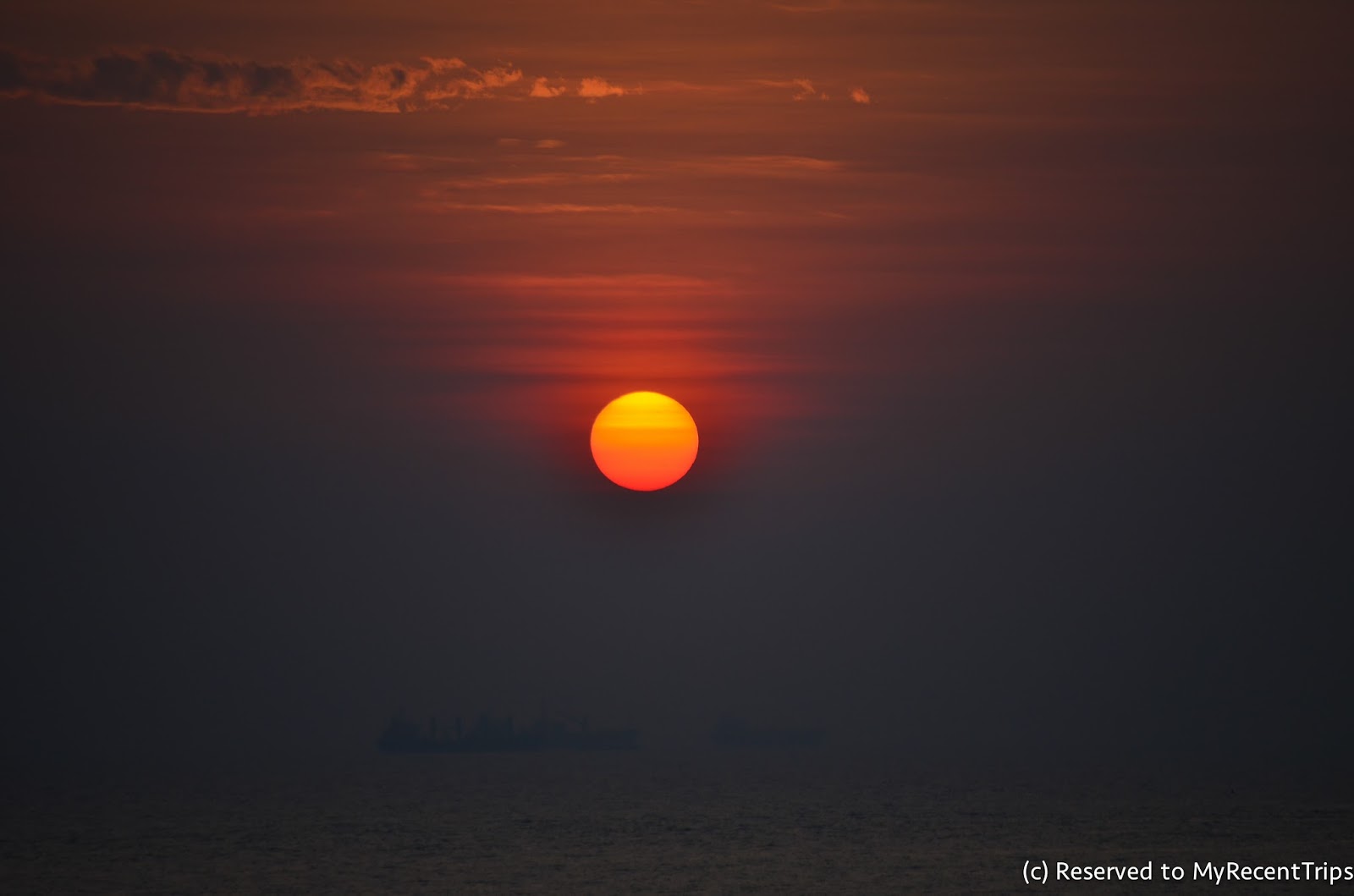
Dona Paula beach is situated at the Sangam of the Arabian Sea and Goan rivers Mandovi and Zuari. There are lots of local legends about the place Dona Paula beach. One of the most famous is, Dona was married to Paulo, a lowly fisherman. He ventured into deep seas for fishing and is said to have never returned. His dutiful wife Dona supposedly waited for him at the jetty, for so many years that she finally turned into stone, which is the famous statue we can see at the jetty.
However, the truth is, Paula Amaral Antonio de Souto Maior. She was married to a Fidalgo from Spain, Dom Antonio Souto Maior. South Maiors was an extremely affluent family, and the entire property from the present day Cabo Raj Nivas all the way to Caranzalem belonged to the Souto Maior’s. Dona Paula was a woman of charity and is known to have helped the villagers and worked a lot for their betterment, so after her death, the villagers decided to rename the village as Dona Paula.
Another famous local legend goes that Dona Paula is supposed to be seen emerging from the moonlit waves wearing only a pearl necklace. Several tourists, as well as locals guided by this myth, visit the beach for a glimpse of Dona Paula.
 |
| Sunset @ Dona Paula Beach |
 |
| Dona - Paula |
While listening all the legends and stories about Dona Paula from our driver Vilas, we enjoyed the enriching sunset.
Oh yes, how can I miss the Bollywood value of this place! This is the place where famous scenes of the movie Singham was shot. One can witness lots of nimbupani, tea stalls are named as Singham ;)
The next place was Miramar Beach. But we had had enough of our beach darshan and were extremely tired and post-sunset it became dark also. So, we decided to skip Miramar beach and headed for our hut.
We reached back Om Sai Hut by 9:00 pm. After enjoying a delicious candlelight dinner at the sea beach, we called it a day.
Day 3: This was the busiest day for us in Goa. The previous day we covered the north Goa beaches, so how can we miss the south Goa beaches. Also, we covered the famous old Goa churches and the not to miss in Goa, Cassino. Here is how the day went for us, After finishing the breakfast we went to the south Goa beaches and the first place on our list was
Patnem Beach is much smaller and less crowded beach than the north Goa beaches. But the roads are very narrow which causes a traffic blockage. On top of that the day we visited, there were quite a number of cars and the entrance was completely blocked. Because of the same, our driver took us to another side beach which was completely empty and Patnem beach was within walking distance from this place. But we decided to spend some time there and leave the actual Patnem beach. The place was rocky, calm and serene and quite a photogenic place.

Next, we visited Palolem Beach, another beautiful and cozy south Goa beach. This beach also has quite a number of beach huts and it must be a superb experience to stay there.
Apart from the beautiful, silent beach, another special attraction of Palolem beach is thrift shops alongside the road. It has a long spread of thrift shops with an awesome collection and much cheaper than the shops of North Goa. We did some shopping there before heading back to our hotel.
Part two of the day started shortly after having lunch and getting a bit freshened up. The places we visited are
Cabo-De-Rama fort is named in the honor of Lord Rama. It is said that the fort was home to Lord Rama and Sita during their exile.
The Cape is crowned with the Fort since ancient times. The fortress was built by Hindu rulers, but during its dramatic history it passed from hands to hands – Muslims, Portuguese, English succeeded one another in the possession of this amazing architecture masterpiece. Some of the most important battles in Indian history took place here.
Restored by the Portuguese in 1763 the Fort had 21 cannons, a chapel, military barracks and commandant's room. From 1935 till 1955 the Fort was used as a prison but then was abandoned. Now the main entrance into the fortress is reconstructed, but the rest of the citadel still lies in ruins, and only one of the walls is completely preserved. Nevertheless, Cabo de Rama Fort is a very attractive touristic attraction.
From the top of the fortress really magnificent view onto the Arabian Sea and the Goan coastline appears to the eye.
 |
| Cabo-De-Rama Fort |
 |
| The gap between two stones was made by cannon blast from the fort |
Rajbag Beach is another beautiful beach. If one wants to stay amidst nature, then Rajbag beach is definitely the place to consider.
 |
| Rajbag Beach |
We couldn’t go inside the main altar of the church as it was booked for a private marriage. However, we could visit the courtyard and the display hall.


One more interesting fact about this church is, the body of St. Francis Xavier is kept inside the basilica. After death, the body of Francis Xavier was first taken to Portuguese Malacca and two years later shipped back to Goa. It is said that the saint's body was as fresh as the day it was buried. Every ten years, the remains of the saint are kept for public viewing during his death anniversary and still attract a huge number of tourists from all over the world. The saint is said to have miraculous powers of healing and many believe that his nails grow till now.
Apart from the exhibition days of saint’s body, it is kept in a silver casket on top of a mausoleum.
 |
| St. Francis Xavier's Casket |
The Sé Catedral de Santa Catarina, known as Se Cathedral, is the cathedral of the Latin Rite Roman Catholic Archdiocese of Goa and Daman and the seat of the Patriarch of the East Indies. It is located in Old Goa, India.
The Se Cathedral's tower houses a large bell known as the "Golden Bell" on account of its rich tone. It is said to be the largest in Goa, and one of the best in the world. The main altar is dedicated to Catherine of Alexandria, and there are several old paintings on either side of it. On the right, there is a Chapel of the Cross of Miracles, where a vision of Christ is said to have appeared in 1619. There are six main panels, on which scenes from the life of Saint Catherine are carved. There is a huge gilded reredos above the main altar.
The Se Cathedral also houses a baptismal font made in 1532 which was used by Saint Francis Xavier in order to baptize several Goan converts.

This church also closes at 6 PM.
The Our Lady of the Immaculate Conception Church is located in Panjim, Goa. This church was first built during 1541 as a chapel however during the 1600s it was replaced by a larger church. n the 18th century the stairways, in a symmetrical zigzag form, were added to the church. The second largest church bell in Goa was installed in a bell tower in 1871.

By the time we reached Panjim, the church was closed so we couldn’t visit the church. However, from the external view, this was the church I liked most.
After a lot of church visiting, it was time for some making some sin :P.
We headed to Casino Pride, one of the premium casinos in Goa. We parked our car opposite to the church at Panjim and walked up to the casino. One needs to keep in mind that all the casinos have a dress code like formals and no shorts and no flip-flops. Entry is strictly prohibited without a proper dress code. Camera, laptop etc are strictly not allowed inside the casino. However, they also have locker facility to keep your belongings.
Entry fees for the casino are Rs 2000/ per head. After buying tickets from the office, we had to board the boat of Casino Pride to reach actual Casino which is situated on a ship in River Mandovi. While buying tickets they give Rs1000/- worth of coupon which can only be used in roulette table and has to be used in multiple of 500/- and also only for limited kind bets. So basically the coupon can be considered as waste.
Also, they have unlimited food and drinks at the table. But the kind of time they take between taking an order and delivering the food, no one will be in the single table. So, that also can be considered as waste.
But if we ignore the freebies at Casino Pride, it is a really good casino with a number of roulette tables and other games. On one of the upper floors, they have a good restaurant and bar as well.
Taking pictures is strictly prohibited inside the casino.
After we were done at the casino, we had dinner at a really nice restaurant called Sher-e-Punjab near to Panjim church and headed for agenda beach. We reached our hotel by 12:30 am.
Day 4: This was a day of complete leisure. We spent entire day sea-bathing, resting. We took our lunch at H2O Agonda, a place with great food and ambiance. We had our dinner at Dunhill, Agonda, another great place.
 |
| Serene Evening at Agonda Beach |

 |
| Evening view of Om Sai beach hut |
We started our day really early at around 4:30 am and checked out from the hotel at Agonda and headed to Dive Goa which is near to Taj Holiday Village. Reporting time at the divining center was 7:00 am. After filling the declaration form, we had a small session on using breathing using oxygen cylinder, do’s and don’ts during diving and sign languages to be used inside water.
 |
| Abir posing during swimming pool session |

There were 5 instructors with us and we were approximately 20 people on board. They got us ready by putting fins, oxygen masks, and oxygen cylinder and one instructor took one person at a time. Finally when my turn came and I was just not able to move due to excitement, tension and a heavy oxygen cylinder being tied to me. But somehow, they managed to get me jumped and it felt like I am drowning inside and water for good and will never be able to come back. But that was just a matter of few seconds and I came out of water floating.
My instructor Kishor was awesome. Before taking me back into the deep water, he made me rehearse all the instruction once again so that I don’t miss breathing or get pain or hurt. Then the moment came when we started going down. With every foot we went inside, the beauty of underwater life came exposing itself.
It was around 20 minutes of dive. We visited a sunken ship and with lots of underwater flora and fauna. This will definitely be going to be one of the memorable experience of my life.


After everyone completed their diving, it was a calm and content ride back to SinQ beach. Someone played the poetry which Farhan Akhtar's did after their scuba diving in the move ZNMD and everyone seemed to literally live the moment of their life.
We were supposed to be back to diving center around 3:00 pm but finally when we reached it was 5:00 pm. We changed in the changing room of Hotel SinQ but there was no proper bathing place. Still-photographs of the diving was included in the package. We paid Rs 250/- per head for the videos.
Here is a short glimpse of my amazing experience.
And here ends our much awaited Goa trip.
For returning back to Bengaluru we booked a bus from Manish Travel. We booked a cab to reach Panjim bus stop from the diving center and it charged Rs 700/-. The bus came half an hour late. There was a stop for dinner at the worst restaurant possible somewhere around 11 pm. We reached Bengaluru next day morning 4 hours late than the actual scheduled time.
Note: From my experience below are the few tips I want to share.
1. For scuba diving, you need to carry your own dress.
2. If you have any plans of returning back or any other activities, make sure to have enough gap between the scuba diving end timings and the next activity. We might have missed our bus if it was not half an hour late.
3. If you are traveling by bus, make sure to carry some food as the restaurants in the ways are waste of money.
Disclaimer: We went on this trip in January 2017. There are chances that price has changed. Please check with Adventure activities, Hotel and local cabs about current rates. I have tried to provide as much as details are possible for the trip. For any further information, feel free to post a comment on the blog or contact me@dutshilpi@gmail.com.


